DEADBODY :: 30 second Teaser ::

DEADBODY :: 40 Second TRAILER ::

Showing posts with label Indian Flag. Show all posts

Wednesday, 23 November 2011

India has lost its freedom to corporate rulers of the west.


The charkha (etymologically related to Chakra) was both a tool and a symbol of the Indian independence movement. The charkha, a small, portable, hand-cranked wheel, is ideal for spinning cotton and other fine, short-staple fibers, though it can be used to spin other fibers as well. The size varies, from that of a hardbound novel to the size of a briefcase, to a floor charkha. 


Mahatma Gandhi brought the charkha into larger use with his teachings. He hoped the charkha would assist the peoples of India achieve self-sufficiency and independence, and so used the charkha as a symbol of the Indian independence movement and included it on earlier versions of the Flag of India.


Charkha is considered the greatest symbolic representation of the centuries and we the Indian's have just ignored one of the profound thought & idea behind the Charkha, that has given us our freedom and we have surrendered to the rule of the imperialism rule of the western economical growth in the name of democracy. 


US President Barack Obama receiving the charkha


India has lost its freedom to corporate rulers of the west. 


We were searching for the Charkha for our film and could not find one in Mumbai 
the one below is a one feet big Charkha that we found in one of the small shop of khadi Gram Udyog (Jaipur) it was in a very bad shape with its handle broken but we bought it for 250/-


Bill of the Charkha 
 The Charkha (1 feet)

  but could not make a replica of it in our film due to lack of time.

Tuesday, 6 September 2011

The deletion of the particular scene as suggested by you will seriously harm the film.


To
CBSE, Mumbai

Dear Sir,

Sub: Request to reconsider our film ‘Deadbody’ for censor


Kindly refer to the short festival film ‘Deadbody’ submitted on 29th  August. In the light of the discussions we had on 30th August regarding the objections of the Censor Board we reviewed our film and also discussed with our producers.

We all are unanimous about the fact that the deletion of the particular scene as suggested by you will seriously harm the film. It’s because all the issues this film deals with converge to the said scene making it most vital portion of the film. 

So we request you to please please reconsider the film for censor.

We’ve spelled out our view points on your objections as discussed on 30th August.


Objections:

Indian National Flag:

  1. No contempt of flag as the character is stating a historical fact only. We have avoided giving any reason or remark about the flag – derogatory, contempt inducing or whatsoever.

You can even notice the character has never once named ‘National Flag’ or ‘Rashtriya Zhanda’!


  1. The national flag we are showing is a pastel coloured sketch drawn by a child – just as the children do in their painting classes. So it also is not a visual contempt of the national flag.

  1. The visual comparison of Ashok Chakra and Charkha is only metaphorical of how we as a nation have forgotten Gandhiji’s idea of economic self reliance of the common man.


Lok-Tantra  Raj-Tantra remark:

  1. The comment is simply an emotional outburst of a common man – a metaphor for what Gandhi had visualized about this country and what it has become instead.  He isn’t playing any office bearer or any political leader of this country. So his words shouldn’t be taken as any official remark on democracy.

Visual interpretation of the common men of the pre and post independent India never changed. Reason: all the British Buildings – the symbols of the Queen’s rule; and all the royal mansions of the erstwhile kings were made into public buildings – from where our leaders ‘ruled’.

Examples are Red Fort and Rashtrapati Bhavan.

  1. An interesting observation by noted journalist Inder Malhotra (pls. refer Edit page, The Indian Express, 15 August, 2011) at the midnight of 14 th August 1947, when people were flogging to the flag hoisting ceremony at Red Fort he noticed this girl who was explaining the event to her kid brother ‘Nehru ki Taz Poshi hai’ ..!

Our character in the film is just expressing these sentiments. He has nowhere insulted Democracy or Lok Tantra. 

..Netaon ki Rajwada ke Ghulam ban kar reh gaye..

1.            In continuation of the above point, the character is in fact making a metaphorical remark on self that the common man never felt independent. Somehow he felt ‘obliged’ to serve the people who in fact were supposed to serve him.

2.            Interestingly people still call ‘Police Colony’, “Teacher’s Colony’, ‘Doctor’s Colony’ and so on – sounding close to the ‘British Colony’ – making a too huge psychological difference between the people who serve the government and who don’t.

3.            So, to reiterate, our film has never ever insulted, criticized or made any uninvited remark on the country or constitution. Instead you can notice, the character is spelling out about himself, criticizing himself - the common man throughout the film. 


Really really hoping for your kind consideration.


With warm regards,

TAMASHA Motion Pictures

{An interesting observation by noted journalist Inder Malhotra (pls. refer Edit page, The Indian Express, 15 August, 2011) at the midnight of 14 th August 1947}


The Ashoka Chakra is represented with 24 spokes. It is so called because it appears on a number of edicts of Ashoka, most prominent among which is the Lion Capital of Sarnath which has been adopted as the National Emblem of the Republic of India.
The most visible use of the Ashoka Chakra today is at the centre of the National flag of the Republic of India (adopted on 22 July 1947), where it is rendered in a Navy-blue color on a White background, by replacing the symbol of Charkha (Spinning wheel) of the pre-independence versions of the flag.

Chakra has always been associated with power/Kings/rulers
Chakravartin(Ashoka the Great)
Chakravartin ( cakra-vartin) is a Sanskrit bahuvrīhi, literally "whose wheels are moving", in the sense of "whose chariot is rolling everywhere without obstruction". It can also be analyzed as an 'instrumental bahuvrīhi: "through whom the wheel is moving", in the meaning of "through whom the Dharmachakra (Wheel of Dharma) is turning" (most commonly used in Buddhism and Hinduism); Pali cakkavatti (also interpreted as "for whom the Wheel of Dharma is turning") is a term used in Indian religions for an ideal universal ruler, who rules ethically and benevolently over the entire world. Such a ruler's reign is called sarvabhauma

In Buddhism and Jainism, three types of Chakravartins are distinguished:

cakravala cakravartin, a ruler over all four continents postulated in ancient Indian cosmography
dvipa cakravartin a ruler over only one of four continents
pradesa cakravartin, a ruler over only part of a continent.

The first references to a cakravala cakravartin appear in monuments of the Maurya period (322–185 BCE), dedicated to Ashoka the Great. It has not been generally used for any other historic figure. The cakravartin in Buddhism came to be considered the secular counterpart of a Buddha. According to Buddha Shakyamuni in the Majjhima Nikaya a woman can never be(come) a chakravartin. Bhikshuni Heng-Ching Shih states referring to women in Buddhism: "Women are said to have five obstacles, namely being incapable of becoming a Brahma King, 'Sakra', King 'Mara', Cakravartin or Buddha."
In general, the term applies to temporal as well as spiritual kingship and leadership, particularly in Buddhism and Jainism. In Hinduism, the term generally denotes a powerful ruler, whose dominion extended to the entire earth.
Mahabharata
In the Mahabharata, twelve princes beginning with Bharata are considered Chakravartins.
Ikshvaku, the son of Ila of the Suryavanshi lineage after whom India was named as Ilavarta and Eelam. In Hindu mythology he is said to have conquered the world.
Bharat was the son of the Puru Dynasty. The official name of the Republic of India, Bhārat in Hindi and Bhāratam in Sanskrit is named after him. He was able to conquer the whole Indian subcontinent. Legend holds that he even conquered regions outside of the Subcontinent such as Afghanistan (then referred to as Gandhara) and Tibet (then referred to as Bhūta).
Shibi, famous in Hindu and Buddhist mythology. He sacrificed his flesh. There have been several dynasties which have claimed heritage from Emperor Shibi's line. The Cholas were one of the dynasties and they referred to him as Sembiyan.
Imayavaramban Neduncheralathan, a Sangam age king said in inscriptions to have conquered up to the Himalayas.

Wednesday, 31 August 2011

Objection from Censor Board :DEADBODY

Censor board has asked us to remove one complete scene from the film : DEADBODY we are consulting. Hoping to get it cleared asap takiing legal advise to get it censored without edit.

The Charkha/Ashoka Chakra in Indian flag(Scene 11 :: Film DEADBODY)


The Charkha ( In the words of Mahatma Gandhi)
Unto The Poor
I THINK of the poor of India every time that I draw a thread on the wheel. The poor of India today have lost faith in God, more so than the middle classes or the rich. For a person suffering from the pangs of hunger, and desiring nothing but to fill his belly is his God. To him any one who gives him his bread is his Master. Through him he may even see God. To give alms to such persons, who are sound in all their limbs, is to debase oneself and them. What they need is some kind of occupation, and the occupation that will give employment to millions can only be hand-spinning.
…. I have described my spinning as a penance or sacrament. And, since I believe that where there is pure and active love for the poor there is God also, I see God in every thread that I draw on the spinning-wheel.

...The spinning-wheel enables us to identify ourselves with cores. The millionaires imagine that money can bring them anything in the world. But it is not so. At any moment death might come and snuff them out…. Losing one's life…is not the same thing as shedding 'self'. One has to learn to efface self or the ego voluntarily and as a sacrifice in order to find God. The spinning-wheel rules out exclusiveness. It stands for all inclusiveness. It stands for all including the poorest. It, therefore, requires us to be humble and to cast away pride completely.

Revival of the cottage industry, and not cottage industries, will remove the growing poverty. When once we have revived the one industry, all the other industries will follow…. I would make the spinning-wheel the foundation on which to build a sound village life. I would make the wheel the centre round which all other activities will revolve.

Message Of The Charkha
I … claim for the Charkha the honour of being able to solve the problem of economic distress in a most natural, simple, inexpensive and business like manner….. It is the symbol of the nation's prosperity and, therefore, freedom. It is a symbol not of commercial war but of commercial peace.

The message of the spinning-wheel is much wider than its circumference. Its message is one of simplicity, service of mankind, living so as not to hurt others, creating an indissoluble bond between the rich and the poor, capital and labour, the prince and the peasant. That larger message is naturally for all.

The message of the spinning-wheel is, really, to replace the spirit of exploitation by the spirit of service. The dominant not in the West is the note of exploitation. I have no desire that our country should copy that spirit or that note.

I do feel that it has message for the U.S.A. and the whole world. But it cannot be until India has demonstrated to the world that it has made the spinning-wheel its own, which it has not done today. The fault is not of the wheel. I have not the slightest doubt that the saving of India and of the world lies in the wheel. If India becomes the slave of-the machine, then, I say, heaven save the world?

Return To Simplicity
If I preach against the modern artificial life of sensual enjoyment, and ask men and women to go back to the wimple life epitomized in the Charkha, I do so because I know that, without an intelligent return to simplicity, there is no escape from our descent to a state lower than brutality.

I believe that no other path but that of non-violence will suit India. The symbol of that DHARMA for India is the spinning-wheel as it alone is the friend of the distressed and the giver of plenty for the poor. The law of love knows no bounds of space or time. My Swaraj, therefore, takes note of Bhangis, Dublas and the weakest of the weak, and except the spinning-wheel I know no other thing which befriends all these.

Wheel Of Life
 Take to spinning [to find peace of mind]. The music of the wheel will be as balm to your soul. I believe that the yarn we spin is capable of mending the broken warp and woof of our life. The Charkha is the symbol of non-violence on which all life, if it is to be real life, must be based.

Some will recall through the wheel the name of that Prince of Peace, Ashoka, the founder of an empire, who ultimately gave up the pomp and circumstance of power to become the undisputed Emperor of the hearts of men and became the representative of all the then known faiths. We would call it a legitimate interpretation of the wheel to seek in it he Wheel of Law ascribed to that living store of mercy and love.

The spinning-wheel thus interpreted adds to its importance in the life of billions of mankind. to liken it to and to derive it from the Ashoka disc is to recognize in the insignificant-looking Charkha the necessity of obeying the ever-moving Wheel of the Divine Law of Love.

… Spinning has become a part and parcel of the Ashram prayer. The conception of spinning as sacrifice has been linked with the idea of God, the reason being that we believe that in the Charkha and what it stands for lies the only hope of salvation of the poor.

It is my claim that the universalization of hand-spinning with a full knowledge of all that it stands for alone can bring that [conquest of inertia] in a sub-continent so vast and varied as India. I have compared spinning to the central sun and the other village crafts to the various constellations in the solar system. The former gives light and warmth to the latter and sustains them. Without it they would not be able to exist.

Duty Of Spinning
Just as every one of us must eat and drink and clothe himself, even so everyone of us must spin himself.

I do not know whether I am a Karmayogi or any other Yogi. I know that I cannot live without work. I crave to die with my hand at the spinning-wheel. I one has to establish communion with God through some means, why not through the spinning wheel? Him who worships Me, says the Lord in the Gita, I guide along the right path and see to his needs.

If every woman in India spins, then a silent revolution will certainly be created, of which a Jawaharlal [Nehru] can make full use. Unless steam generated is put to proper use, the engine will not run and the person generating the steam may himself be scalded by it even unto death.

A scientific study of the spinning-wheel will lead on to Sociology. The spinning-wheel will not become a power for the liberation of India in our hands unless we have made a deep study of the various sciences related to it. It will then not only make India free, but point the way t o the whole world.
'Livery Of Freedom'
…While Khadi is good for the poor as an honourable occupation for earning bread, it has an additional and far greater value as an instrument of winning Swaraj through non-violence means.

In 1908, in South Africa, I conceived the idea that, if poverty-stricken India were to be freed form the alien yoke, India must learn to look upon the spinning-wheel and hand-spun yarn as the symbol, not of slavery, but of freedom. It should also mean butter to bread.

Khadi to me is the symbol of unity of Indian humanity, of its economic freedom and equality and, therefore, ultimately, in the poetic expression of Jawaharlal Nehru, "the livery of India's freedom."
Moreover, Khadi mentality means decentralization of the production and distribution of the necessaries of life. Therefore, the formula so far evolved is, every village to produce all its necessaries and a certain percentage in addition for the requirements of the cities.
Heavy industries will needs be centralized and nationalized. But they will occupy the least part of the vast national activity which will mainly be in the villages…..

Since the wanton destruction of this central village industry and the allied handicrafts, intelligence and brightness have fled from the villages, leaving them inane, lusterless, and reduced almost to the state of their ill-kept cattle.

Economic Regeneration
I feel convinced that the revival of hand-spinning and hand-weaving will make the largest contribution to the economic and the moral regeneration of India. The millions must have a simple industry to supplement agriculture. Spinning was the cottage industry years ago, and if the millions are to be saved from starvation, they must be enabled to introduce spinning in their homes, and every village must repossess its own weaver.

It bears not a message of ill-will towards t he nations of the earth but of good-will and self-half. It will not need the protection of a navy threatening a world's peace and exploiting its resources, but it needs the religious determination of millions to spin their yarn in their own homes as today they cook their food in their own homes.

I may deserve the curses of posterity for many mistakes of omission and commission, but I am confident of earning its blessing for suggesting a revival of the Charkha. I stake my all on it. For every revolution of the wheel spins peace, good-will and love. And with all that, inasmuch as the loss of it brought about India's slavery. Its voluntary revival with all its implications must mean India's freedom.

Hope Of Rural Masses
I have often said that, if the seven lakhs of the villages of India were to be kept alive, and if peace that is at the root of all civilization is to be achieved, we have to make the spinning-wheel the centre of all handicrafts.

The spinning-wheel represents to me the hope of the masses. The masses lost their freedom, such as it was, with the loss of the Charkha. The Charkha supplemented the agriculture of the villagers and gave it dignity. It was the friend and solace of the widow. It kept the villagers from idleness. For the Charkha included all the anterior and posterior industries-ginning, carding, warping, sizing, dyeing and waving. These in their turn kept the village carpenter and the blacksmith busy.
The Charkha enabled the seven hundred thousand villages to become self-contained. With the exit of the Charkha went the other village industries, such as the oil press. Nothing took the place of these industries. Therefore, the villages were drained of their varied occupations and their creative talent and what little wealth these brought them…. Hence, if the villages are to come into their own, the most natural thing that suggests itself is the revival of the Charkha and all it means.

I have no doubt in my mind that the wheel can serve as the instrument of earning one's livelihood and, at the same time, enable the worker to render useful service to his neighbours…. In order to ply the wheel intelligently, he should now all the processes that precede and succeed spinning.

The conviction dawned upon me even before I came to India that the revival of hand-spinning alone could restore India to its pristine glory. I have since compared the spinning-wheel to the central sun round which the solar system of our village economy revolves. It provides the golden bridge between the rich and the poor.

The Charkha is not like either the small or large machines of the West. There cores of watches are produced in a few special places. They are sold all over the world. The same tale applies to the sewing machine. These things are symbols of one civilization. The Charkha represents the opposite.
We do not to universalize the Charkha through mass production in one place. Our ideal is to make the Charkha and all its accessories in the locality where the spinners live. Therein lies the value of the spinning-wheel. Anything that goes wrong with it should be put right on the spot and the spinners should be taught how to do so.

Mill Industry
Our mills cannot today spin enough for our wants, and if they did, they will not keep down prices unless they were compelled. They are frankly money-makers and will not, therefore, regulate prices according to the needs of the nation. Hand-spinning is therefore designed to put millions of rupees in the hands of the poor villagers. Every agricultural country requires a supplementary industry to enable the peasants to utilize the spare hours. Such industry for India has always been spinning. Is it such a visionary ideal-an attempt to revive an ancient occupation whose destruction has brought on slavery, pauperism and disappearance of the inimitable artistic talent which was once all expressed in the wonderful fabric of India which was the envy of the world? 

Do I seek to destroy the mill-industry, I have often been asked. If I did, I should not have pressed for the abolition of the excise duty. I want the mill-industry to prosper-only I do not want it to prosper at the expense of the country. On the contrary, If the interests of the country demand that the industry should go, I should let it go without the slightest compunction.

In my opinion, the mill-hands are as much the proprietors of their mills as the share-holders, and when the mill-owner realize that the mill-hand are as much mill-owners as they, there will be no quarrel between them. 


Monday, 15 August 2011

The True Indian Flag :: with Charkha

idea to include 
Charkha 
was to make 
Indians self reliant
The charkha (etymologically related to Chakra) was both a tool and a symbol of the Indian independence movement. The charkha, a small, portable, hand-cranked wheel, is ideal for spinning cotton and other fine, short-staple fibers, though it can be used to spin other fibers as well. The size varies, from that of a hardbound novel to the size of a briefcase, to a floor charkha. Mahatma Gandhi brought the charkha into larger use with his teachings. He hoped the charkha would assist the peoples of India achieve self-sufficiency and independence, and so used the charkha as a symbol of the Indian independence movement and included it on earlier versions of the Flag of India.


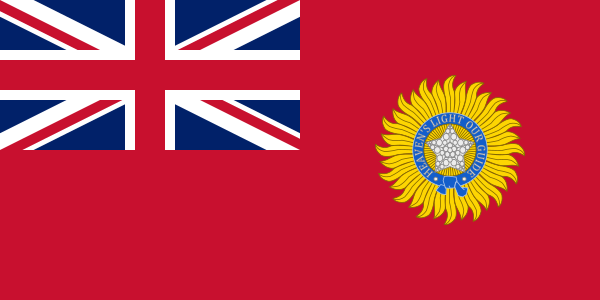
India was under British rule in the 19th century. A number of flags with varying designs were used in the period preceding the Indian Independence Movement by the rulers of different princely states; the idea of a single Indian flag was first raised by the British rulers of India after the rebellion of 1857, which resulted in the establishment of direct imperial rule. The first flag, whose design was based on western heraldic standards, were similar to the flags of other British colonies, including Canada and Australia; the blue banner included the Union Flag in the upper-left quadrant and a Star of India capped by the royal crown in the middle of the right half. To address the question of how the star conveyed "Indianness",Queen Victoria created the Knight Commander of the Order of the Star of India to honour services to the empire by her Indian subjects. Subsequently, all the Indian princely states received flags with symbols based on the heraldic criteria of Europe including the right to fly defaced British red ensigns

Flag of British India, 1858–1947
In the early twentieth century, around the coronation of Edward VII, a discussion started on the need for a heraldic symbol that was representative of the Indian empire. William Coldstream, a British member of the Indian Civil Service, campaigned the government to change the heraldic symbol from a star, which he considered to be a common choice, to something more appropriate that would bind the people to the Kingdom of Great Britain. His proposal was not well received by the government; Lord Curzon rejected it for practical reasons including the multiplication of flags. Around this time, nationalist opinion within the dominion was leading to a representation through religious tradition. The symbols that were in vogue included the Ganesha, advocated by Bal Gangadhar Tilak, and Kali, advocated by Aurobindo Ghosh and Bankim Chandra Chattopadhyay. Another symbol was the cow, or Gau Mata (cow mother). However, all these symbols were Hindu-centric and did not suggest unity with India's Muslim population.
The partition of Bengal (1905) resulted in the introduction of a new Indian flag that sought to unite the multitude of castes and races within the country. The Bande Mataram flag, part of the Swadeshi movement against the British, comprised Indian religious symbols represented in western heraldic fashion. The tricolour flag included eight white lotuses on the upper red band – representing the eight provinces, a sun and a crescent on the bottom green band – representing the Hindu and Muslim population respectively, and the Bande Mataram slogan in Hindi on the central yellow band. The flag was launched in Calcutta bereft of any ceremony and the launch was only briefly covered by newspapers. The flag was not covered in contemporary governmental or political reports either, but was used at the annual session of the Indian National Congress. A slightly modified version was subsequently used by Madam Bhikaji Cama at the Second Socialist International Meeting in Stuttgart. Despite the multiple uses of the flag, it failed to generate enthusiasm amongst Indian nationalists.
Around the same time, another proposal for the flag was initiated by Sister Nivedita, a Hindu reformist and disciple of Swami Vivekananda. The flag consisted of a thunderbolt in the centre and a hundred and eight oil lamps for the border, with the Vande Mataram caption split around the thunderbolt. It was also presented at the Indian National Congress meeting in 1906. Soon, many other proposals were initiated, but none of them gained attention from the nationalist movement. In 1916, Pingali Venkayya submitted thirty new designs, in the form of a booklet funded by members of the High Court of Madras. These many proposals and recommendations did little more than keep the flag movement alive. The same year, Annie Besant and Bal Gangadhar Tilak adopted a new flag as part of the Home Rule Movement. The flag included the Union Jack in the upper left corner, a star and crescent in the upper right, and seven stars displayed diagonally from the lower right, on a background of five red and four green alternating bands. The flag resulted in the first governmental initiative against any nationalistic flag, as a magistrate in Coimbatore banned its use. The ban was followed by a public debate on the function and importance of a national flag.

Gandhi's flag, introduced at the Congress meeting in 1921
In the early 1920s, national flag discussions gained prominence across most British dominions following the peace treaty between Britain and Ireland. In November 1920, the Indian delegation to the League of Nations wanted to use an Indian flag, and this prompted the British Indian government to place renewed emphasis on the flag as a national symbol. In April 1921, Mohandas Karamchand Gandhi wrote in his journal Young India about the need for an Indian flag, proposing a flag with the charkha or spinning wheel at the centre.[10] The idea of the spinning wheel was put forth by Lala Hansraj, and Gandhi commissioned Venkayya to design a flag with the spinning wheel on a red and green banner, the red colour signifying Hindus and the green standing for Muslims. Gandhi wanted the flag to be presented at the Congress session of 1921, but it was not delivered on time, and another flag was proposed at the session. Gandhi later wrote that the delay was fortuitous since it allowed him to realise that other religions were not represented; he then added white to the banner colours, to represent all the other religions. However, soon the Sikhs wanted the banner to include the black colour and Gandhi was forced to address these issues in his writings and speeches. Finally, owing to the religious-political sensibilities, in 1929, Gandhi moved towards a more secular interpretation of the flag colours, stating that red stood for the sacrifices of the people, white for purity, and green for hope.
On 13 April 1923, during a procession by local Congress volunteers in Nagpur commemorating the Jallianwala Bagh massacre, the Swaraj flag with the spinning wheel, designed by Venkayya, was hoisted. This event resulted in a confrontation between the Congressmen and the police, after which five people were imprisoned. Over a hundred other protesters continued the flag procession after a meeting. Subsequently, on the first of May, Jamnalal Bajaj, the secretary of the Nagpur Congress Committee, started the Flag Satyagraha, gaining national attention and marking a significant point in the flag movement. The satyagraha, promoted nationally by the Congress, started creating cracks within the organisation in which the Gandhians were highly enthused while the other group, the Swarajists, called it inconsequential. Finally, at the All India Congress Committee meeting in July, at the insistence of Jawaharlal Nehru and Sarojini Naidu, Congress closed ranks and the flag movement was endorsed. The flag movement was managed by Sardar Vallabhbhai Patel with the idea of public processions and flag displays by common people. By the end of the movement, over 1500 people had been arrested across all of British India. The Bombay Chronicle reported that the movement drew from diverse groups of society including farmers, students, merchants, labourers and "national servants". While Muslim participation was moderate, the movement enthused women, who had hitherto rarely participated in the independence movement.

The Swaraj Flag, officially adopted by the Congress in 1931
While the flag agitation got its impetus from Gandhi's writings and discourses, the movement received political acceptance following the Nagpur incident. News reports, editorials and letters to editors published in various journals and newspapers of the time attest to the subsequent development of a bond between the flag and the nation. Soon, the concept of preserving the honour of the national flag became an integral component of the freedom struggle. While Muslims were still wary of the Swaraj flag, it gained acceptance among Muslim leaders of the Congress and the Khilafat Movement as the national flag. Detractors of the flag movement, including Motilal Nehru, soon hailed the Swaraj flag as a symbol of national unity. Thus, the flag became a significant structural component of the institution of India. In contrast to the subdued responses of the past, the British Indian government took greater cognisance of the new flag, and began to define a policy of response. The British parliament discussed public use of the flag, and based on directives from England, the British Indian government threatened to withdraw funds from municipalities and local governments that did not prevent the display of the Swaraj flag.The Swaraj flag became the official flag of Congress at the 1931 meeting. However, by then, the flag had already become the symbol of the independence movement.

Indian Flag, the first stamp of independent India, released on 21 Nov 1947, was meant for foreign correspondence.
A few days before India gained its freedom in August 1947, the Constituent Assembly was formed. To select a flag for independent India, on 23 June 1947, the assembly set up an ad hoc committee headed by Rajendra Prasad and including Maulana Abul Kalam Azad, Sarojini Naidu, C. Rajagopalachari, K. M. Munshi and B.R. Ambedkar as its members. On 14 July 1947, the committee recommended that the flag of the Indian National Congress be adopted as the National Flag of India with suitable modifications, so as to make it acceptable to all parties and communities. It was also resolved that the flag should not have any communal undertones. The spinning wheel of the Congress flag was replaced by the Chakra (wheel) from the Lion Capital of Ashoka. According to Sarvepalli Radhakrishnan, the chakra was chosen as it was representative of dharma and law. However, Nehru explained that the change was more practical in nature, as unlike the flag with the spinning wheel, this design would appear symmetrical. Gandhi was not very pleased by the change, but eventually came around to accepting it. The flag was proposed by Nehru at the Constituent Assembly on 22 July 1947 as a horizontal tricolor of deep saffron, white and dark green in equal proportions, with the Ashoka wheel in blue in the centre of the white band. Nehru also presented two flags, one in Khadi-silk and the other in Khadi-cotton, to the assembly. The resolution was approved unanimously.It served as the national flag of the Dominion of India between 15 August 1947 and 26 January 1950, and has served as the flag of the Republic of India since then